Showing posts with label learning programmes. Show all posts

Thursday, 7 September 2017

Mana Enhancement

Mana Enhancement

A culturally centered Model of your own creation                               

Te Ara Whakamana- The enhancement model uses  narratives ,colour  and metaphor to explore the uniqueness of the individual and their world

The Maori creation story
Papatunuku ( earth mother)   Ranginui ( Sky father)  created the Atua ( gods )

A NZ Model if you want to adapt it you can

MANA 20170906_103750.jpg
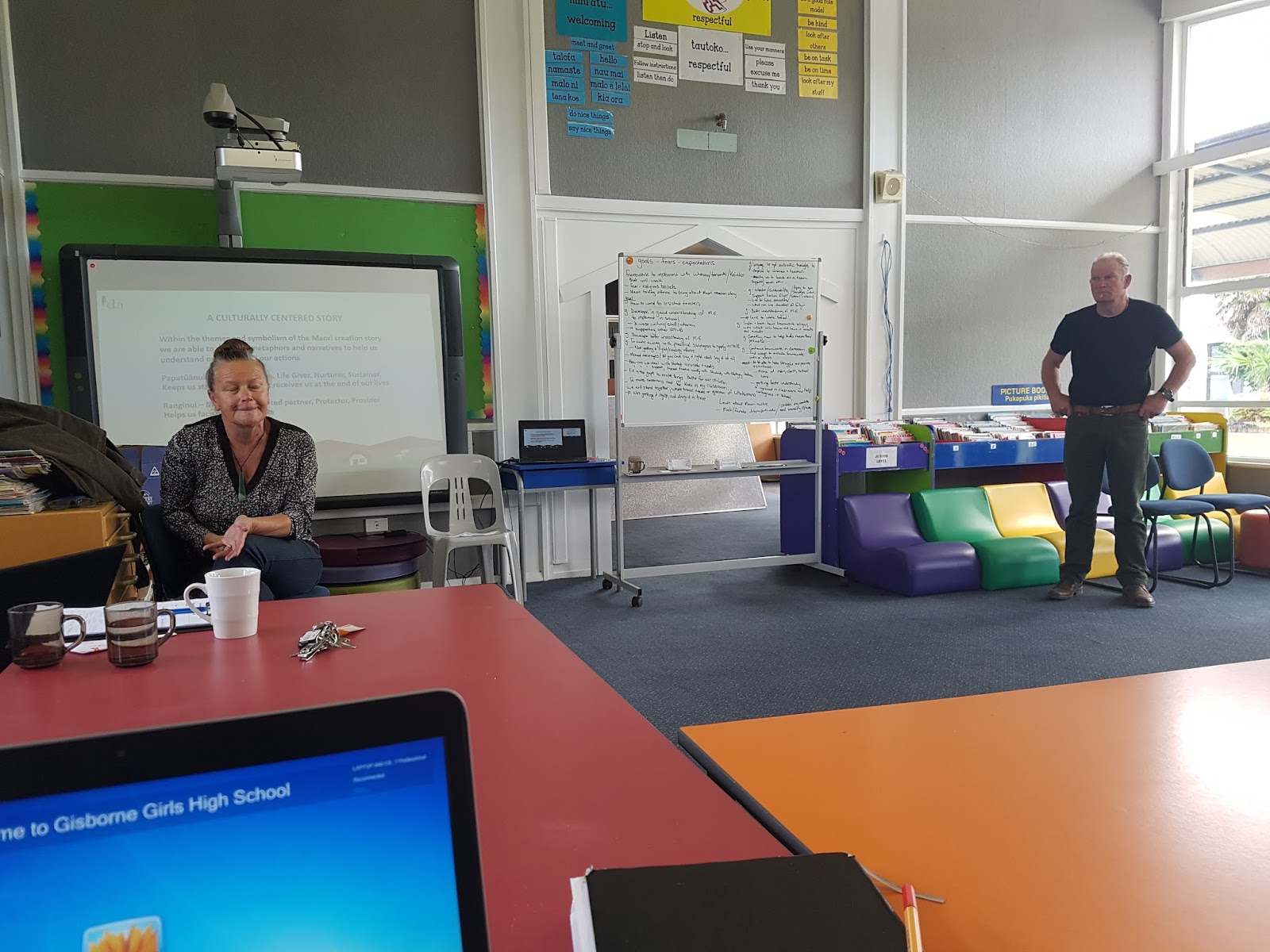
Ma - White/purity         pure about ourselves
Ana -care tinana
Seed /can be tainted if you need mana to be the best you can be
Identity
Whakapapa
It is the feeling of the person/anything is possible Wairua
Pride, power,respect

At the centre is the uniqueness of the individual and their Mana

Its about Mana

Mana Atua- Sprirtual
Mana tangata-skills and talents,thoughts and deeds
Mana Tane
Mana wahine
Mana Tamariki/Mokopuna
Mana whenua- our relationship with the land
Tangata Whenua-indigeneity

Not here to replace. This will enhance your practice

3 other tenets

Whakamana Mana enhancement            Strengths based          Ako -Co Construction

Ako teacher being the learner the learner being the teacher

Model will grow    both grow
Looking for strengths of charecter and culture

School wide/whanau

A culturally centred story
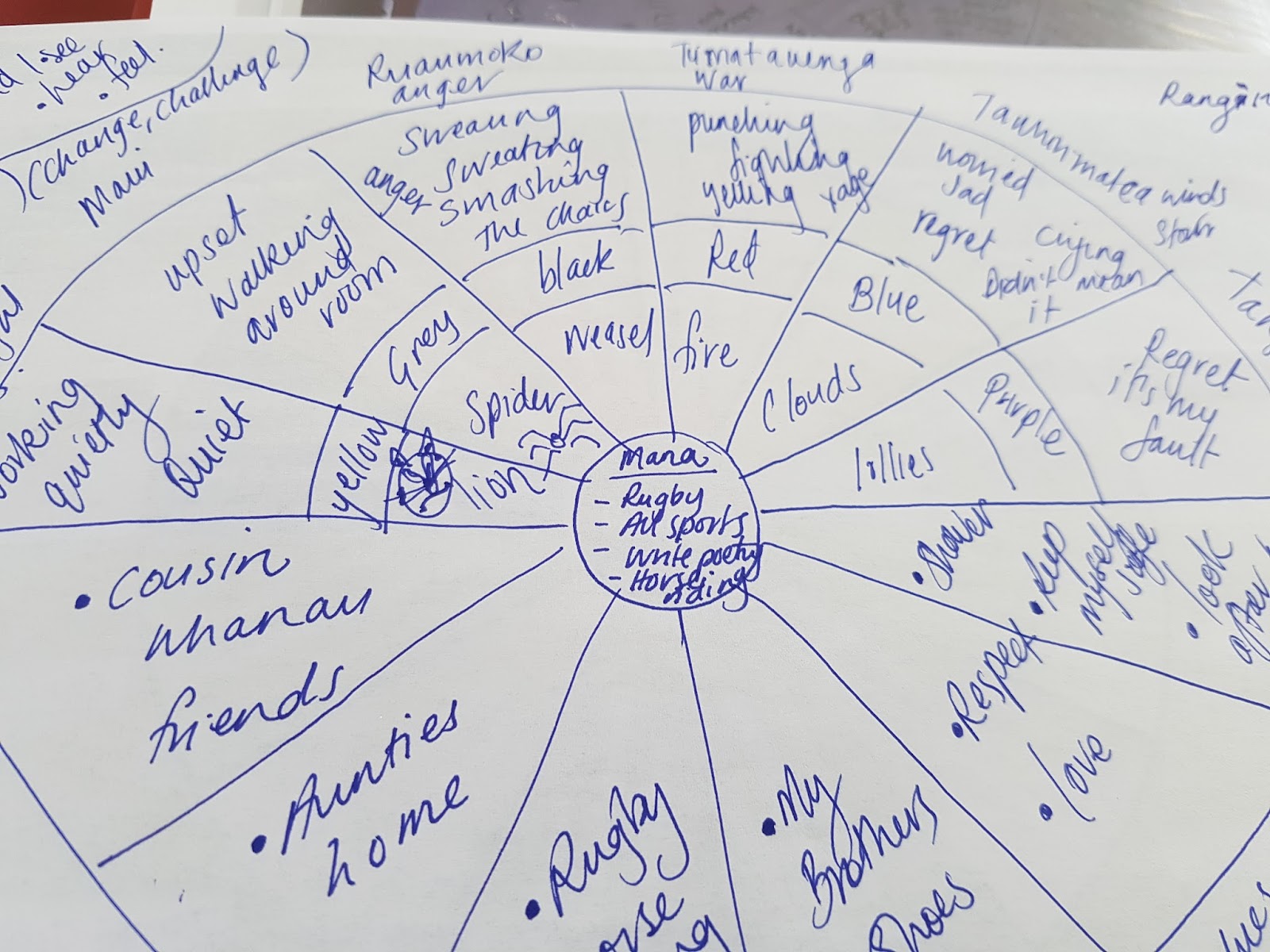
20170906_122252.jpg

What fits the person is important

Using an indigenous framework for a narrative enquiry

About what  nurtures, calms, sustains and strengthens

Mana is enhanced
Brilliant actions and exceptional talent will be noticed and enhance ones Mana

Actions that cause harm, will also be noticed and will have a negative effect on Mana- It will diminish

Setting the environment with a karakia
In their voice how they said it student voice we don’t challenge we except in this moment
Model of inquiry

As a class what does Mana mean to us as a class

What is hidden visible

Stories
Korero around Mataora
Niwareka

Maui

Maui the adventurer- He wanted to see how far he could go and what he could achieve
Maui the trickster- He could be a bit naughty and hoha
Maui who had a bad start- He was left for dead as a baby
Maui the shape shifter- Sometimes he had to get himself out of trouble

Maui who created positive change for everyone

PB4L conference

Image result for pb4l conference nz 2017


http://www.pb4lconference.co.nz/

Notes from Conference


Dr Terry Scott - Effective use  of positive reinforcement


The most powerful use of intervention we know of but can only be used when the student is correct


  • Avoid use of tangibles ( food,toys,items)
  • Use more group contingencies


Keys to facilitating Sustainable change
  • Provide a logic Why should I do this
  • Teach discrimination - Do I understand the Keys
  • Discuss relevance- How could I use this with my kids
  • Observe and evaluate


Frequent feedback


Learning curve-Acquisition, Fluency, Maintenance, Generalization


Acknowledge success


Level 1 Verbal Praise- age appropriate thanks, I appreciate, I’m impressed.. Deliver with specificity. Mix it up-superlatives  exactly,super,perfect,thank you


Level 2 access to privilege
  • Things that already exist and are used- It's the recognition you have worked well today you can be the first to leave
  • Make contingent  


Level 3  Public Acknowledgement
  • For those who like it
  • For those deserving more
  • Free


Level 4  Token Reinforcement
  • For specific behaviours,times & contexts
  • Token may be the reinforcement
  • Trade for existing privileges
  • Drawings and chances of winning
           Prizes should be part of the curriculum- Need to use today


Acknowledge errors with correction


  1. Feedback that behaviour is inappropriate
  2. Re teach appropriate behaviour
  3. Facilitate success with positive feedback


Children should not be removed from the room it teaches them nothing- unless it is a safety issue. Same as suspension


CIBRS.com


PBIS.org


Bullying Prevention


Web site


Defining
Prevention
Teaching
Reacting
Measuring


Whole school approach


PB4L Restorative Practice


Kintsukuroi
To repair with gold the art of repairing pottery with gold or silver Lacquer and understanding that the piece is more beautiful  for having been broken


What does this mean to you


Gold is more valuable,  Strength added stronger than before, gold enrichment,slow careful process an art,craft to it


Restorative is not simply a system it's a way of being
Restorative Practice is about
Relationships- building-maintaining-restoring sustaining


The social Discipline Window
To punitive            With restorative
Confrontation            Problem solving
Win/lose                    respectful
Authoritarian                  collaboration
Stigmatising                taking responsibility


Not neglectful               For Permissive
Indifferent                         protecting
Unsafe                                   rescuing
Lazy                                       undemanding
Given up                                 excusing


3 phrases of PB4L Restorative
Preparation- Participation- Follow up
Restorative model kite


Sheridan.gray @ waikato.ac.nz for powerpoint

I-Cept-Behavioural optometry


A free assessment tool to identify auditory processing and visual processing difficulties
Time consuming with detailed assessments results.
Web based - emailing of reports

All ages
SENCO
Teachers
Assessment tool
Support students with reading difficulties

☆☆☆☆☆
Ease of use:
1 - 2 - 3 - 4 - 5
Tech level:
Novice

I cept

Trial 6 questions-each category

100 questions- numbers  flashing  red  stars ∗  on different sides then a number input the number. Numbers on left/right/middle

Half way through choice to have a break

Visual Span, Left/right

Numbers on either side of the star    ∗   6 ∗1
Input the numbers  eg 6 1

How many circles in the green  box. 85 questions. Numbers vary between 1 and 9
Visual spatial
Numbers/letters and numbers tick or cross if the right or wrong way
Auditory  Discrimination
Which sound is the loudest
Which sound is the highest
Which sound has a gap
Which sound is the highest the first or second

Behavioural Optometry
  • Convergence Insufficiency …….The visual system requires two distinct sets of abilities to perform optimally.
    1.The two eyes must send a clear, single, comfortable image to the brain
    2.The brain must be able to process the information and make sense of what is seen; this requires good visual processing skills
    In an ideal visual system, the two eyes are straight and parallel when looking into the distance, and turn in (converge) a moderate amount towards each other when seeing up close.
    Convergence insufficiency is a condition in which the two eyes can’t turn in (converge) enough when looking up close, meaning the two eyes struggle to send a single and comfortable image to the brain. Convergence insufficiency may be unrelated to being long-sighted or short-sighted, and so even though a child can see clearly, the brain is still struggling to process the image.
    Compensating for convergence insufficiency results in either (1) the muscles working harder to pull the eyes together to maintain convergence, causing strain, or (2) the brain only selectively using only one eye to focus up close; the other being ignored then relaxes and turns outwards.  Convergence insufficiency causes the accommodation (focussing) system to have a tendency to prefer to focus at distance, and struggle to focus up close.
    The combination of struggling to focus up close, and not being able to use both eyes comfortably together to see up close causes the following common symptoms;
  • Eye strain (asthenopia)
  • Double vision (diplopia) (though if the brain ignores an eye, this won’t be perceived)
  • Headaches
  • Blurred vision or ghosting of images at near
  • Perception of moving print when reading
  • Eye tracking and fine-motor movement difficulties
  • Difficulty concentrating
  • Squinting or closing one eye

Wednesday, 6 September 2017

One day Conference-July Holidays

LEARNING FOR ALL ACROSS THE SECTOR
One-Day Conference
Monday 17th July 2017


Nāku te rourou nāu te rourou ka ora ai te iwi
With your basket and my basket the people will live


Dr Ann Milne
Dr Ann Milne is the former principal of Kia Aroha College, a designated-character secondary school in Otara, Auckland. 
Ann is a strong critic of pervasive, deficit-driven explanations of “achievement gaps” and Māori and Pasifika “under-achievement”.
Ann is the author of Coloring in the White Spaces: Reclaiming Cultural Identity in Whitestream Schools
Keynote — Coloring in the White Spaces: Reclaiming Cultural Identity in Whitestream Schools

Workshop 2 — What is success? Different perspectives through the self-learning lens and the connected-learning lens.


Assoc Prof. Andrew Gibbons
Andrew is a teacher educator and Associate Professor at AUT’s School of Education. He has worked in journalism, in the social services in England and in early childhood education in Auckland.

Andrew has a keen interest in philosophy and politics, and these orient his research of education generally, to questioning beliefs and practices, and their impact on the experience of being human.

He has published widely on topics including the early childhood teaching profession, Aotearoa New Zealand early childhood education policy, approaches to early childhood curriculum, the educational implications of the work of Albert Camus, the philosophy of education, the role of technology in education, and the future of the university.

Editor in Chief – eLearning and Digital Media
Workshop 1 — What school leaders might consider in planning to engage with ILEs — new designs in learning environments, and shifting expectations of teaching in such spaces.